
Transcript
Dr. McDonough:
What happens when data from a patient's smartwatch starts influencing real clinical decisions? For one Stanford doctor, that moment signaled a shift in how we think about chronic disease management.
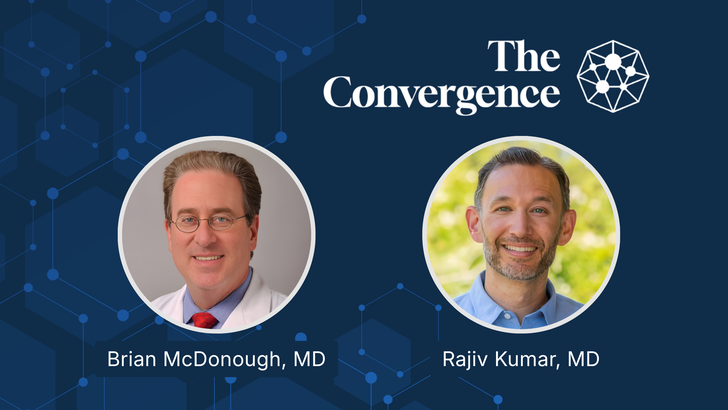
Welcome to The Convergence on ReachMD, where innovators and physicians explore the technology transforming medicine. I'm Dr. Brian McDonough, and today I'm joined by Dr. Rajiv Kumar, who's a physician-researcher at Apple, as well as an Adjunct Clinical Professor of Pediatric Endocrinology and Diabetes at Stanford Medicine.
Dr. Kumar, welcome, and thanks for being here.
Dr. Kumar:
Thank you for having me, Brian. This is an excellent opportunity. I'm looking forward to talking.
Dr. McDonough:
You are practicing at Stanford while working with one of the world's largest tech companies—congratulations, by the way. How did you end up at that intersection? It's fascinating.
Dr. Kumar:
It's a bit of serendipity. So I came out to Stanford more than 15 years ago to complete my fellowship, and I had the opportunity to stay on as junior faculty and serve as the Medical Director of Mobile Health for our children's hospital. And this was just around the time of mobile devices becoming more prevalent, data becoming more within the control of a given patient, and more ways of sharing data in between systems.
Apple had announced the launch of HealthKit around 2014. You can think of it as a secure spreadsheet that lives behind your apps on your iPhone or iPad and allows you as a user to pick and choose which data elements you'd want to share with other apps. With privacy at the core, that information doesn't live on an Apple server; it's all under your control in your device. At that time, in the pediatric endocrinology clinic, we were trying to figure out how to get more home data available for assessment in between visits. That’s particularly important for pediatrics, where kids are growing and developing, and they have variability in their lifestyle from semester to semester or sport to sport. And HealthKit immediately offered a solution, saying basically any glucometer or continuous glucose meter that pairs with the iPhone and writes to HealthKit—that data can be read with the user's permission by our patient portal app.
And so that's how I met the team and got to work using HealthKit and did a fantastic pilot. And then the opportunity came up to join about 10 years ago, and so I've come over since 2016.
Dr. McDonough:
It's interesting. I can tell you're an active clinician because your two first thoughts that you were talking about—one was privacy of the information and protecting it for patients, and then also trying to deal with the frustrations so many of us have, because people leave the office and then they're lost to follow-up or you don't know what they're doing. And especially for something like pediatric endocrinology, that's huge. You’ve got to get those numbers.
When did you first think, “This consumer device can actually play a role in patient care?” A really cool concept: something a consumer buys that can help in their own patient care.
Dr. Kumar:
It's been an evolution. I think it first really hit me when we started to get data on that pilot. So before I was at Apple, we started to see trends in one patient basically in her blood sugar, where it was dipping low on Tuesdays and Thursday nights. I just sent her a screenshot through the patient portal app and asked her, "What do you think is happening here?" And she knew the answer. She knew exactly what happened. She knew it was specific to those nights, and she knew how to modulate her insulin profile accordingly and made the changes. Her parents were on CC, and the changes happened two weeks after our visit.
Otherwise, it would've been maybe three months before I saw her again and we had that discussion. So it seemed that with the home data, she knew what to do with it, she could take action on it, and she was suddenly empowered when it was surfaced to her in a visualized way.
I think since then, seeing the reaction in the community from people having near continuous access to their heart rate, making observations about their data, what affects their data, how that changes, and then having more and more tools and more and more information surface to them and empowering them has been really quite moving. People literally write letters to our CEO indicating this has changed lives—sometimes saved lives—and empowered them with that information or education about themselves.
Dr. McDonough:
One of the things you're bringing up, which is interesting, is empowering the patients. But also, when you're dealing with that with them, it gets them more involved and more active in their care. Have you seen better responses because they're having some control over their health condition?
Dr. Kumar:
Absolutely. The level of engagement has gone up exponentially with the amount of information and the pieces that people are putting together. It is actually increasing efficiency. So imagine me trying to retrospectively look at someone's glucose and ask questions about their activity, their sleep, their menstrual cycle, or whatever it may be. Collectively, we can figure things out and piece it together, but by surfacing information and putting it together in concert of other data elements in their lives, they're making connections, bringing those connections forward, and asking really educated questions beyond what I had ever seen in the years prior to this data just being liberated and at their fingertips. So the engagement is there for sure.
Dr. McDonough:
I want to talk a little bit about integrating this information into the electronic health systems we have. That's been a battle for all of us. Whatever model we have at our hospitals, there are technical and clinical challenges, and challenges of getting consumer information into the electronic records. So with that, let's talk about integration. What types of consumer generated data are actually useful in practice, and what tends to get ignored?
Dr. Kumar:
Yeah, a fantastic topic. So first of all, the amount of data and the types of data that are available on the device are quite varied. So it's absolutely first-party information from an Apple device, but any device that can pair to your iPhone or iPad is remarkably helpful. And so those could be glucose meters, scales, thermometers, or blood pressure cuffs—whatever it may be. Once the data is there and under the user's control, it can be shared and leveraged by whomever they give access to. And so let's talk a little bit about that journey from the provider side and then the patient user side, and then how those connect
From the provider side, I'll tell you the story of when we first set up the connection. When we were just piloting it, I said, "This is great. Let me know every blood sugar that comes in, and if it's high or low, just send me a note in my mailbox." And within 10 minutes, I was like, "This was a terrible idea." The point is not to be inundated with data; it's more to empower the user. They already know what to do with the data. We've taught them what to do if they have high blood sugar or low blood sugar. It's more so that I'm trying to look at the trends and help provide that extra layer of interpretation.
So one thing was A, asking for the data, and then B, knowing when to look at the data. And it's not every time it enters a system, but more so on a given cadence. And even then, is there a reason that I need to look at the data, or can that be surfaced to me when there's something actionable? And what are the patterns you're looking for? What is actionability? Is it percent hypoglycemia overnight? Is it estimated hemoglobin A1C that's too high? Is it overall hyperglycemia at certain times of the day? That's up to each individual provider, clinic, or practice. Then you figure out your plan and how to set the appropriate expectations with the patient.
So there's been a lot of studies, even before mobile devices, indicating that if a patient thinks you have real-time access to their data, they might expect that you're looking at it and be really irritated you didn't call when something was off, or when they may assume you would've known this happened. And so then we worked to really set expectations with patients and their families, saying, “We're not looking at this data. It's the same as it was before. If you have a question, you can call us. You can send out a message through MyChart or whatnot. We have the ability to open it if you'd like us to, and sometimes we might look in the background and send a question or call.”
But basically, we set that expectation and started to break through any magical thinking, and that's been great. Basically, people know what to expect, and then they know how to interact with that moving forward.
Dr. McDonough:
That's an interesting point, and the whole idea of managing expectations—I know when I'm training young doctors in family practice, I'm like, “I don't say this in a negative way, but you’ve got to train your patients about when they should call and when they shouldn't call.” Back in the old days, you'd be on the phone all weekend answering every particular question. But you can manage the expectations: “I want critical information, and I will be here 100 percent of the time for critical information, but if something can wait, let's let it wait. If you're not sure, certainly call me.” But essentially, we’re doing the same thing that we did in the old telephone world when you were dealing with data.
Dr. Kumar:
That's right. It's the same concept of communication and expectation, and so we have to set that bar. It's not wrong to call or all those things, but we didn’t want people to think at two in the morning when they had a low blood sugar that suddenly I was aware or would call them or take action just because it's being communicated. I think that's incredibly important.
Then, from the provider side, it's really determining what data elements you want and in what combination you want them. And so you can request a data-element by data-element perspective. And so it might be mobility features—walking and stability—that could predict when they might have a fall or might be getting closer to needing more help with ambulation. It could be specific heart rate trends. It could be related to the menstrual cycle. It could be related to hearing tests when someone's on an ototoxic medication and you want to do home trending. It's infinite, the information you may request.
But it’s having a plan of what you're going to do with that information, and as you said earlier, closing the loop on how a patient should expect to interact with that or what they might expect from the provider. And not planning to look at this one data element at a time, but really taking that opportunity of all of that home data and all of the stuff that happens in between those clinic visits—what's really going on? How are these medicines working? How are they affecting different vital signs? Having a plan to assess that in the background and visualizations to look at that so you're not losing efficiency. The idea is that you engage the patient in their care with your discussion without losing efficiency, and then also have the outcomes that you expect.
Dr. McDonough:
One of the things that I had in my role as a Chief Health Informatics Officer, where we put through Cerner and then later Epic—many of the tools had been built by engineers and not clinicians. They were running things in terms—I had no idea what they meant. But once they became a little more clinical, it made more sense to me and also with other healthcare providers. It appears to me that your work at the beginning with Apple was, let's start with the way the clinician's thinking, and let's look at HealthKit integration, but also look at what we need as doctors. Was that one of the reasons why you got on board? Was it that use of your skills and talents?
Dr. Kumar:
So I think initially, certainly, I was looking at the world of, how does this make communication with a patient more efficient in between visits? And then looking at that from the patient perspective, what are their pain points? And I found that was much easier when I started asking or looking and thinking about that, and those were the questions Apple was asking.
Then, when I came over, one of the motivations was understanding that journey from the patient perspective because they're really in control of their care. They're really in control of whether or not they use a medication, how they use it, and their understanding of it. If it's not a medication, is it a lifestyle modification? And really, what are the outcomes going to be? And so the real innovation or magic in these next steps of healthcare is, how do you engage, empower, inform, and continue to motivate the user along their journey?
So absolutely everything we do here within health and fitness has a clinician involved. We have engineers, designers, patient advocacy groups, human factors, and engineering. And we test how things might land from users across age spans, including users who have never used the iPhone and users who have never used a smartphone before, to ask, “Is this going to be confusing? How do we make this the simplest, most effective experience possible?” And that's just unique.
Dr. McDonough:
You have so many different voices and talent groups to call upon. You're in the field of endocrinology; it's a great one for monitoring and seeing changes. We're always worrying about hemoglobin A1Cs and the trend in those things. And so you've worked with continuous glucose monitoring in both clinical and also consumer contexts; how has integrating data like that changed things? Because clearly, that's real time—it's moving, and we're not just getting the snapshot. We're getting a real-world view of glucose issues.
Dr. Kumar:
I'll share a personal story. I think along this journey within health, I've had some arrogance in really thinking, “I understand the human body. I understand how things work. I've studied really hard, and I have so many patients that wear CGMs. I understand how my metabolism works under the hood.” I remember the first time I wore a CGM, and I don't have diabetes, but all these things I assumed about myself and my own personal health were really inaccurate, and it helped me to understand the decisions I was making weren't as informed as I thought they were. And that was really eye-opening.
Then, coming to Apple and having questions around nutrition, sleep, and the relationship and the interplay of all these things with activity and mental health and mindfulness—I realized I didn't have as strong of an understanding as I assumed I had, and that there were a lot of data elements that I thought understood that truly weren't understood by me, even though they were actionable simply by the fact of being near continuous. So even near-continuous heart rate, when that was shipped on the first Apple Watch, suddenly people were writing in and telling stories of how they discovered these underlying conditions that they didn't know they had, or these patterns that were there based on elements in their lives that they discovered just because it was available.
That was the same journey I had with my glucose. “Oh, I get these values every five to 15 minutes. I can really see how stress affects me. Lack of sleep affects me,” and other such variables. So then, in that journey, we had a heart rate surface. Then there was high heart rate and low heart rate notifications. Then there was the concept of irregular rhythm. Then, the ability to double check things with an ECG, trend and track those, and share those back with your doctor and making a PDF to close the loop. There's tons of learnings there in two worlds coming together—the patient journey and the clinician making use of this data—to understand what's going on in the body.
Dr. McDonough:
Hypertension's another issue. How has that been affected?
Dr. Kumar:
Basically, the beauty of a device and things that are in the background of your life is you're using them for other reasons—to listen to music while we work out, or to get a notification when the kid's ready to be picked up from school—whatever it may be. But it's on your body. It can be there when you sleep. It can be there when you're awake. And that gives a lot of opportunities for passive opportunistic assessments—not a screening or diagnostic test, but just looking to see if there’s something actionable there.
At the pure benefit of being at the wrist, we can use the optical heart sensor to look at the vessels when one is at rest and compare it to what would be expected. And if a vessel is more consistent with someone with stage one or stage two hypertension, we can surface that to a user, make that actionable, and make them aware of it. And that's really fantastic because as hypertension is a silent disease. It often goes underdiagnosed. There's great guidelines out there as to when to screen and to continue to monitor, but many people aren't doing those often; it gets lost in a typical clinic visit. And so the ability to just be looking in the background and surfacing is really exciting. It’s a similar story for sleep apnea and other patterns we may not know we have. And the earlier we find these things, the more actionable they become, and the better outcomes we can achieve.
Dr. McDonough:
You've addressed it a little bit, but I wanted to follow up about digital clutter. There's so much information. I remember reading something saying we're literally drowning in information. There's so much. How do you get through the clutter and find, as you say, the actionable data?
Dr. Kumar:
There's three principles that drive everything we ship. And so you touched on a really important one: privacy, at the core. And so all the information belongs to users and lives on their device. It goes where they want it to go, and they can use it as they wish.
Two, everything needs to be rigorously scientifically validated. We ship devices to countries and regions all around the world, and so we need to validate and be able to explain our validation amongst diverse and wide groups. And we have the ability to do that because of the pure reach of our devices as well.
But three, information needs to be actionable. And so if we're surfacing something to you, it's not meant to scare you. It's not meant to be an FYI. But if a notification comes to you, that's a big sign, right? If we over notify people with everything, then it loses effectiveness. And so when you onboard onto the devices, you know what information can be surfaced. You get background as to what to expect and what not to expect.
And then when it comes about, it really should be something that you know what to do with next. We either help with that, or if you're taking that to your healthcare provider, they know what to do with it next. And they trust it because of the rigorous validation they get and the information they need, and they know those next steps. That's what makes it truly actionable.
Now, some users can get overwhelmed. There can be lots of information and lots of data. Again, that's all under their control. They can turn those off. They can look at just what they want to look at. They can look at things in concert of other variables and however it makes the most sense to them. But the idea is to be in the background, not to make you log in or look at data every day.
Dr. McDonough:
For those just tuning in, you're listening to The Convergence on ReachMD. I'm Dr. Brian McDonough, and I'm speaking with Dr. Rajiv Kumar about consumer technology and how it's entering clinical workflows.
Let's take a look at what this means for patients a little more globally. In your experience, what changes when patients and their families have continuous access to health data?
Dr. Kumar:
I think even just the awareness of it and being able to trend and understand how those variables fit together. And so an anecdote from my world is, prior to the type of education and information being available in the health app, I often found that conversations about menstrual cycles with adolescents or preadolescents were quite difficult or sometimes could be awkward, particularly if their parents were in the room or family members were in the room. For whatever reason, that was a stigmatized thing or difficult to talk about. Once that data became available and widely available on devices, paired with really targeted education material, that allows people to learn about their bodies, what's normal, and what to expect, and introduces vocabulary. Then I started to see a shift where people were coming in and asking questions, using the words, discussing it with their parents, trending things, and showing me their graphs in PDF form.
And so I think it's really that change and engagement of coming to the doctor to figure out what's going on, to understanding what's happening and when things might be changing or maybe not quite as expected, and then having that informed and patient-led conversation. So I think it's just changed where that notice of understanding is.
Dr. McDonough:
So when we look at real outcomes and what really matters, what have been some of the actual data that you've used that has changed the prognosis or the course of the disease in the patients you treat?
Dr. Kumar:
That's an exciting question because there's so many data types and elements that are available. Certainly, we study those. We watch the post-market analysis. We also have programs like our Investigator Support Program where we give grants of devices to researchers around the world who are looking at data elements that we surface or notifications or whatnot. And also looking into them in novel populations, particularly from specific disease states or whatnot, they found that it's been helpful even in disease monitoring or training and tracking things. But things that excite me are areas that maybe typically don’t get a lot of attention and then suddenly become part of that normal vernacular. And what happens next?
So, at the moment, it's hard to choose one, but the one that's most exciting for me is the hearing test, and then the ability to use the hearing aid feature with AirPods Pro. We know from the ACHIEVE trial and otherwise that hearing loss is one of the largest modifiable risk factors for dementia. It's certainly a large, high prevalence condition. And the earlier we intervene, the better outcomes we have, not only for cognition, but even cardiac risk factors, mobility risk factors, and otherwise.
And so by offering the hearing test from AirPods Pro on your iPhone or iPad, you now have the ability to capture an audiogram at home. It takes less than five minutes to do both ears if you're in a quiet environment. We have lots of built-in mechanisms and checks and balances in place so you can get really trustworthy results that are comparable with an in-clinic exam. And so that's one example of real-world outcomes where suddenly people who are affected and didn't know they're affected, now know and can take the next steps. And the next steps are potentially available from the same device they took the test on.
Dr. McDonough:
It's great you bring that one up because with geriatric patients, with family members, with others, and a lot of people, for whatever reason, they'll freely say, “I have a problem with my vision.” But many people just don't want to admit they're having hearing issues, and they deny it. But when they've seen it on their own—in their own tests and devices—I would think that's more impactful because nobody's telling them. They find out on their own and probably try to explore it.
Dr. Kumar:
That's right. And you can find it out earlier, you can trend it and look at variables that might be contributing to it, but it becomes, again, your empowerment. But you're right, I don't know why that stigma is there for hearing health where it's not there for vision health and otherwise. We have found that, similar to the menstrual cycle story earlier, that talking about it, being very public about it, and having people of all different age groups and backgrounds taking power and controlling that and using hearing protection and hearing aids really has destigmatized it for a lot of populations.
Dr. McDonough:
One of the things I have patients say to me—and I've heard this a number of times, and I understand it—is, “I want this data, but then I again, I don't, because I'm afraid if I know if my heart's beating irregularly or something else is happening, I'm going to get more anxious, and all of a sudden I'm going to be obsessed with my health. I don't want constant access to health information.” How do you deal with that with them? Clearly there are advantages, but you also could become obsessed.
Dr. Kumar:
So all of these are under one's control. They can turn off any notifications. You can turn off any information and have that fade into the background, and look at it whenever they want, or look into the summary or in concert of other data. But agree that for some people, it can be overwhelming, and so they should pick what fits best for their journey.
Dr. McDonough:
I've told my patients who bring that up, “It's almost like you have investments or retirement; don't look at it every day.” Or, “Don't weigh yourself every day. Pick your spots, and then it becomes less annoying and bothersome.” And I think that's a really good point you're making. People do have the ability, just by pressing a button, to say what they want or don't want. Do you also explain that to them and say, “Hey, this is what you’ve got, but here's how I suggest you use it. If you have questions about it, let me know.” Do you have those conversations?
Dr. Kumar:
Even before these mobile devices, we had those conversations quite frequently in the diabetes clinic because continuous glucose monitors give so much frequent information. And so the idea here is that you're getting data to understand trends. It's not good or bad. It can be higher than expected or lower than expected, but really you're stepping back to say, “What does this mean?” Or, “How does the information fit together?” And so it tends to be in clinic when discussing things when we say, “Hey, when you're looking at this number, you should have a plan,” or “You should know what happens next.”
And we try to have a similar approach when you're surfacing information in the app or when we're showing visualizations. We’re really trying to make it the most understandable possible so you know what to do next or if there's anything to do next. But the concept here is, again, not just to surface numbers and judge, or say, “This is scary or not scary” or whatnot, but, “Here's what's happening and what this could mean.”
Dr. McDonough:
We've talked about ownership, and clearly, there are protections for the patients built in. In fact, it's one of the three things you were talking about focusing on—to make sure that's protected. But what about internally in family data ownership, with parents and patients and how that's shared? I would assume it’s not that different than when everyone's together talking about things, but if parents can peek in on things or kids can, does that come up?
Dr. Kumar:
It's something we think a lot about—the flow of information and what information is under your control. And so for instance, my mom shares some of her health data with me. She can do that at a data element level, so it's the health sharing option within the health app. And so she shares her sleep data; when she checks her blood pressure with her paired blood pressure cuff, she shares that with me. She doesn't share other things with me that perhaps she doesn't want me to bother her about or ask about. And so again, that's completely under her control.
When setting up a device for an adolescent or a child, again, there are certain control factors. There are certain elements there saying what can be shared and what can't be shared.
Dr. McDonough:
It's interesting. One of the things that comes up—and I've talked about this on other programs—I train young doctors, and those in training are so much better because they're native users of much of this technology. And so I can only imagine with their minds looking at tools like this, it's going to get even wider and better because they're going to be thinking of things that maybe, for somebody in my generation, it wouldn't even occur to.
Dr. Kumar:
That's one of the fun parts of the Investigator Support Program. We see a lot of trainees, students, residents, and fellows who are using these devices in ways that I could have never imagined, certainly not when I was at their stage of training. But when I think of heart rate, I think, “Here's heart rate. I can see if it's going higher or if it's going lower.” They might be thinking, “How could heart rate help me predict when the ins and outs are going to be imbalanced in the ICU after a procedure?” Or, “How can I help trend this data element when someone's transitioning from hospital to home?” And just really clever models where it's not data for the sake of data, or data to understand an underlying physiology, but to empower that patient journey and increase efficiency. And so really exciting stuff is happening locally and around the world.
Dr. McDonough:
Perhaps the most exciting, at least in my opinion, part of this entire conversation is about to happen. Where's the industry headed? What should physicians understand about the consumer-clinical convergence, and what are we looking at? Things seem to be moving so rapidly.
Dr. Kumar:
Things are changing fast for sure. I just think from about 10 years ago until now, there's been quite a significant amount of advances that have happened. But at the same time, there's also some stuff that's going incredibly slowly, where I think there's room for significant advancements over the next coming years.
And so things that are going fast are having a better understanding of what's happening in our patients' lives and in between visits, and using that home data in concert of their clinical data to help tell that overall story without increasing time of review and otherwise. And so I think the ability to understand someone as a whole and how the pieces fit—sleep, activity, metabolism, all of these coming together—is unparalleled.
I think as clinicians, we need to continue to gain familiarity with data—how to look at data, how to look at data in concert, and really, to empower ourselves and make that actionable. And I find that's part of the training of the fellows in our program and residents around the world. And so I think that is acclimating and happening as we speak.
I think the parts that are going slower than I would've anticipated in this stage is the wide-scale research. Folks have mobile devices and these wearable devices. These are diffusely available in our population amongst all socioeconomic statuses and all backgrounds. and we find that studies that are launching are quite diverse and give lots and lots of information. But often, throughout the course of a study or that course of progress, it sometimes shifts as to who's sharing data or what's being shared. And so having that trust in, how is data moving? How does it reach your doctor? How does it reach a researcher? What is that data being used for transparently? What's happening with it? I think all of that is really required to help allow these studies to go forward so that all of the universities and all of the great minds around the world can continue to discover and innovate.
Dr. McDonough:
The whole idea of clinical validation now as opposed to the past world of maybe a decade ago with typical medical device validation is shifting as the real world gets involved.
Dr. Kumar:
That's right. The real world is the key topic there. We have the opportunity to really understand what happens when someone leaves the clinic room and they're home. How are things interacting? Is it working?
I think telehealth was a really interesting experience during the pandemic, particularly in the diabetes clinic. We're meeting patients who are at home as opposed to in the clinic room, and it's a completely different interaction. Someone's cooking in the background, there's like a cat walking by, and there's the TV blurred in the corner. This is the real world. And when we try to implement simple lifestyles changes, like, “Why don't you replace this with zucchini?” Whatever feels really great in an after-visit summary might not make sense at all in what's happening in the real world.
And so these digital metrics are things that can be tracked to help tease out what's normal, where there’s an aberration from normal, and what variables might be contributing to that.
Dr. McDonough:
As more technology companies enter the healthcare world, how should clinicians and researchers think about trust and responsibility around the evolving technologies? There's going be a lot more voices there and responsibility that companies take.
Dr. Kumar:
Perfect question. So I think just like anything else, if there's a new lab assay, new imaging, or new technology, really understanding, do I trust it? How is it validated? Is it relevant to my patient population? And so for anything we release, we make it publicly available. You can go to Apple.com/health and see the background validation studies and all the different features and how they fit together.
But I think the key is, can I trust this information? How do I use this information, and is it relevant to my patient population? Really doing that rigorous kind of assessment before implementing into care.
Dr. McDonough:
I know things are constantly changing and evolving, but how should clinicians approach consumer device-generated patient data? Are there any green lights or red flags from your perspective, or things they should be thinking about?
Dr. Kumar:
So I think understanding, again, just like other data elements, what's the cadence? What are ways that could make something look artificial or something that may be misinterpreted? And so we try to be very thoughtful about all those things and surface that in our PDFs and in our reports.
For example, if you were to use Apple Watch and wanting to look back to see breathing disturbances that might be consistent with sleep apnea, how does that trend maybe month-to-month or year-to-year? If you don't know that someone didn't wear their watch for all of February and had zero breathing disturbances, you might overlook that or miss and say, “February was a good month. What was going on in February?” And so just being cognizant, again, just like any other data element, was it actually measured? How frequent was the measure? And how does that compare as if I'm trending over time?
Dr. McDonough:
One of the most difficult things for me as a practicing clinician during the pandemic was realizing that I thought I had all my patients buttoned up and cared for so well, and then I saw those who had preexisting conditions or who basically did not have the resources to take the medicines or get the care they need—how quickly they were the ones who COVID-19 actually aggressively attacked. As we wrap up, these tools are becoming more embedded in care. How do you think they're going to help with health equity, and how we can help those who perhaps need this information the most to benefit from this technology? And are there those who we fear might be left behind?
Dr. Kumar:
The mobile technology is so diffuse and so available. And really, it is the primary source of how many people access the internet. And so in lieu of a computer or other expensive devices, a mobile device is almost in the hands of almost every adult these days. And with all of the sensors on the devices and all the things that compare it to the devices, there's more opportunity to trend or monitor things in between so one has better understanding of their health. But probably one of the most important things there is the camera and the ability to do video conferences, and to do telehealth when one maybe isn't able to leave home or doesn't have access to traditional healthcare or whatnot. And so I think that's really important.
For us, it's a big part of our mission and what we think of any sort of health product or health feature. We try to think of how we can take this back to as many devices as possible—that retrograde compatibility. And so as long as we maintain our accuracy and our performance spec, do we have all the appropriate sensors? Do we have all the appropriate computing computational power and everything that we need to make it reach the most amount of people possible?
So for example, this past fall, we shipped the signs of hypertension feature, even though we also shipped a new Apple Watch. At that time, it wasn't limited to that new Apple Watch; it went back several series. So again, we can reach as many people as possible. I think because the devices were there and they last so long, they often get passed down in families or shared or used in secondary markets, there's an opportunity to reach more and more people as the years progress.
Dr. McDonough:
A couple final questions as we wrap up: first, what's one thing clinicians should start paying attention to right now in the consumer health space?
Dr. Kumar:
Okay, great question. I have the opportunity to work with learners, and so this one comes up a lot. Getting familiar with data and what to expect from data—I think we all get it as part of our training, and we understand screening tests and diagnostic tests, and sensitivity and specificity and when that makes sense. But in the real probabilistic model of healthcare, when you're working with a patient or you're working with a population and figuring out what to do next, these types of devices and digital wearable technology are not the same as a screening test or a diagnostic test. These are passive opportunistic assessments that happen in the background, and we’re understanding what to take from that and what not to take from that and what strong performance is. So in this case, I would argue really understanding the benefits and harms of false positives and false negatives and where positive predictive value might be the right variable to think about things. One shouldn't expect to put on a device and figure out if they have a disease because it’s not truly a diagnostic, but rather if a device happens to be worn and says there's a pattern, there’s that actionable understanding of what comes next.
And so that's two answers there: knowing how to understand that data you're getting, but also knowing how to look at data and make critical assessments of that data, including from multimodal sources all at once.
Dr. McDonough:
My final question: what's one thing you wish every clinician understood about this intersection of consumer tech and clinical care?
Dr. Kumar:
It all fits together, and it's there. It's available at your fingertips, basically being able to help tell that story in the concert of one's life—so not the disease that's being treated or the medication that you’re assessing, but how do all of these pieces fit together, including sleep, activity, nutrition, metabolism, mental health, and mindfulness? How can we complete that story for our patients? And so just having that comfort and access to that information and making it usable.
Dr. McDonough:
This has been fascinating. Dr. Kumar, thank you so much for joining me today and sharing your perspective on this ever-evolving space.
Dr. Kumar:
Of course. Thank you for inviting me. I enjoyed the time.
Dr. McDonough:
You've been listening to The Convergence on ReachMD, where innovators and physicians explore the technology transforming medicine to hear about other technological advances shaping the future of healthcare, visit The Convergence on ReachMD.com, where you can be part of the knowledge. Thank you for listening, and we'll see you next time.
